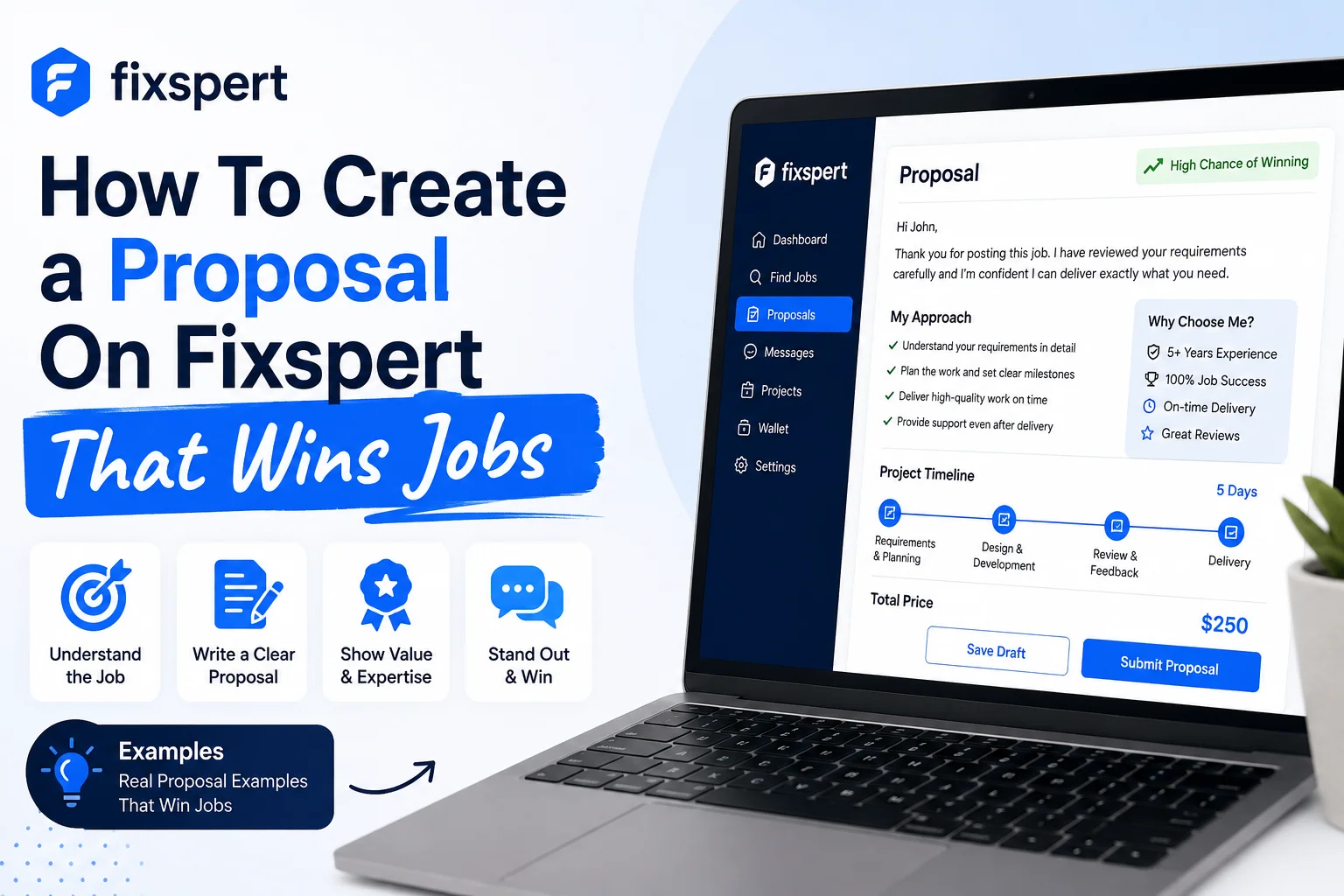

Winning consistent work on Fixspert doesn't come down to being the cheapest bidder or having the most years in the trade. It comes down to one thing most pros get wrong: the proposal itself. A generic, copy-pasted pitch gets ignored — even from a great contractor. A specific, well-structured proposal gets replies, even from a newer pro with fewer reviews.
This guide walks through exactly how to write a Fixspert proposal that stands out, with real before-and-after examples you can adapt for your own jobs.
Why Your Proposal Matters More Than Your Price
Homeowners posting jobs on Fixspert usually receive several competing proposals within hours. Most of them read the same: a short, generic blurb mentioning years of experience and a request to "message me for details." Clients skim past these quickly.
What actually gets a response is a proposal that proves three things in the first ten seconds of reading:
You read their specific job, not just the category.
You know how you'd solve their exact problem.
You're easy and low-risk to hire — clear price, clear timeline, clear next step.
The sections below break down how to hit all three, every time.
The Anatomy Of A Winning Proposal
Every strong Fixspert proposal follows the same basic shape. You don't need to write an essay — most winning proposals are under 120 words — but each of these five elements should show up somewhere.

Step-By-Step: Writing Each Section
1. Open with their name and their job
Skip "Hello, I hope this finds you well." Start with the client's first name (Fixspert shows it on the job post) and a one-line reference to what they actually posted. This alone filters you out of the "mass-messaged everyone" pile.
Try this opener formula: "Hi [Name] — saw your post about [specific problem]. [One sentence showing you understand what's going on]." |
2. Diagnose before you pitch
Clients trust pros who explain the "why," not just the "I can do it." If the job description mentions a symptom (a leak, a noise, a crack, a delay), name the likely cause in plain language. This does two things: it proves expertise, and it lets the client mentally picture you already on the job.
3. Give a real timeline and approach
Vague responses ("I can start whenever") read as low-commitment. Instead, give a concrete window: "I can be there Thursday afternoon" or "This is usually a 2-3 hour job, done in one visit." Specific beats fast — clients would rather wait three extra days for someone who clearly knows what they're doing.
4. Back it up with one proof point
You don't need a portfolio in the proposal box. One well-chosen proof point outperforms a long resume:
• A specific past job similar to theirs ("I replaced a cartridge faucet just like this last week")
• A credential relevant to the task (licensed, insured, certified)
• Your Fixspert review count or rating, if strong
Pick whichever is most relevant to that job — not the same proof point for every proposal.
5. Quote clearly and end with a next step
Ambiguous pricing ("depends, let's chat") loses jobs to pros who just give a number. Where you can, offer a fixed price or a tight estimated range. Close with a low-friction call to action — a question is often stronger than "let me know," because it invites a reply.
Closing line examples: "Does Thursday morning work, or is this more urgent?" "Want me to swing by for a quick look first, or are you ready to book the fix?" |
Before & After: A Real Example
Here's the same plumbing job — a leaking kitchen faucet — pitched two different ways. Both proposals came from pros with similar experience. Only one gets a reply.

Notice what changed: the strong version names the likely cause, gives a specific fixed price, references review history, and offers a concrete time slot — all in about the same word count as the weak version.
Pricing Your Proposal: Fixed vs. Estimate
How you quote matters almost as much as the number itself.
• Use a fixed price whenever the job scope is clear from the photos and description — it removes risk for the client and speeds up booking.
• Use a tight range (not a wide one) when scope is uncertain, and explain what would move the price up or down.
• Avoid quoting far below market rate to "win the bid" — it invites scope disputes later and trains clients to expect underpricing.
• If you need to see the job in person first, say so explicitly and offer a free or low-cost assessment visit instead of a vague number.
Common Mistakes That Sink Proposals
• Sending the same message to every job, unedited
• Leading with your years of experience instead of the client's problem
• No price, or "contact me for pricing" with no other detail
• Walls of text — most clients decide within seconds on mobile
• Typos or leftover placeholder text from a saved template
• No clear next step, leaving the client to do the follow-up work
Quick Checklist Before You Submit

Putting It Together
A winning Fixspert proposal isn't longer or more impressive than the competition's — it's just more specific. Reference the exact job, explain your approach in plain terms, quote clearly, and give the client an easy way to say yes. Do that consistently and your reply rate — and your booked jobs — will climb, regardless of how many other pros bid on the same post.